
Basics
Can a thermal camera see through walls?
A thermal camera sees the surface of a wall, never behind it. What looks like x-ray vision is heat reaching the surface — which is why it finds pipes.
Updated
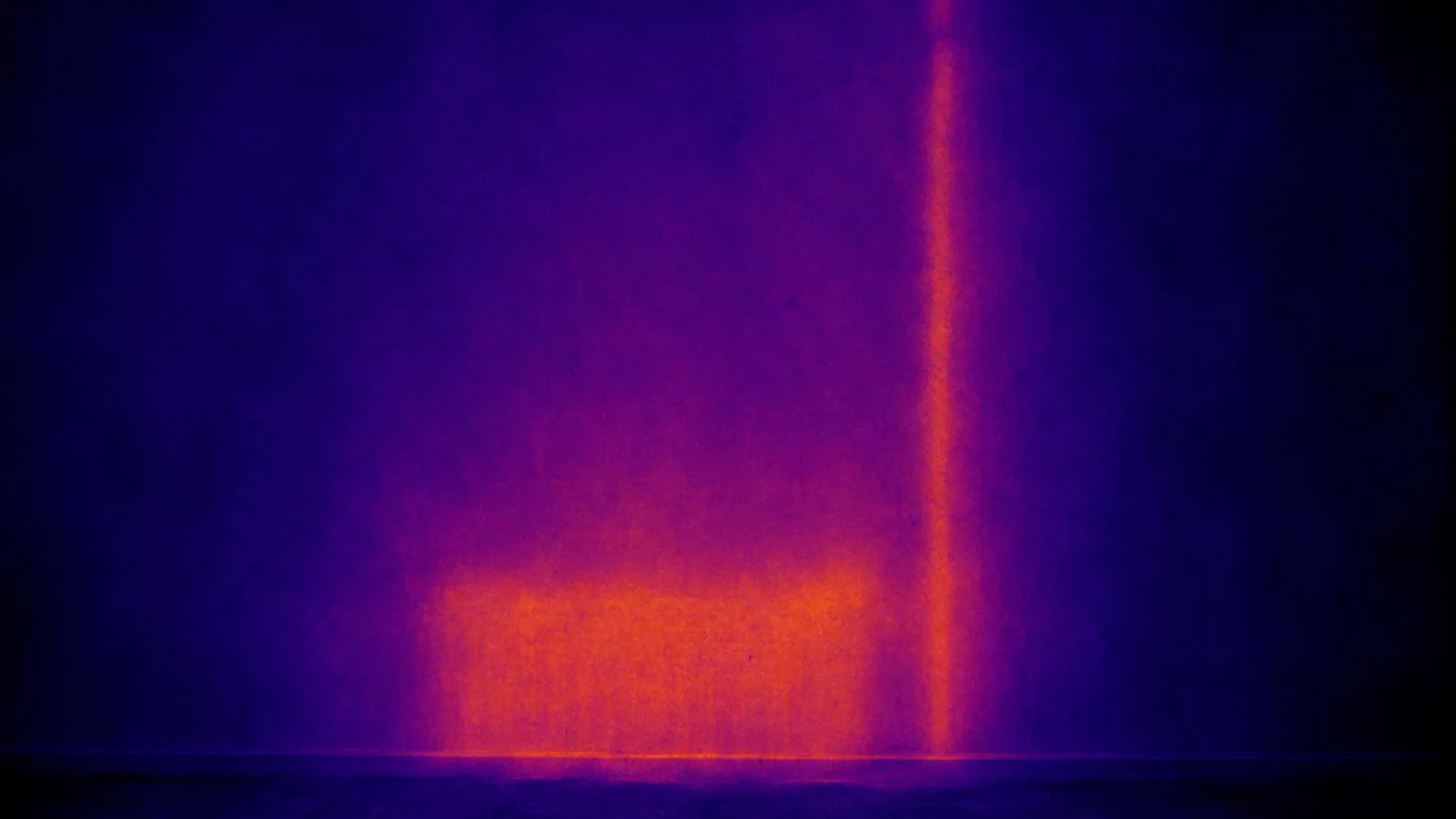
No. A thermal camera cannot see through a wall, and neither can any app, any drone or any military device sold to civilians. It sees the surface of the wall — and that turns out to be more useful than the myth.
Why it stops at the surface
Thermal imaging reads long-wave infrared, around 8 to 14 micrometres. Plaster, brick, timber and plasterboard are completely opaque at those wavelengths. Radiation from behind the wall never reaches the lens; what does reach it is radiation from the wall’s own outer face.
So when you point an imager at a wall you are photographing the wall, exactly as a normal camera would — just in temperature rather than colour.
Then why do pipes show up?
Because heat conducts. A hot pipe behind plasterboard warms the board above it. After a while that warmth reaches the outer surface, and the surface is what the camera sees. You get a soft, blurred stripe exactly where the pipe runs.
Three things follow from that, and they all matter in practice:
- It is delayed. Switch the heating on and it can take twenty minutes before the pipe shows. Switch it off and the stripe lingers.
- It is blurred. Heat spreads sideways as it travels outward, so a 15 mm pipe can show as a 60 mm band.
- It needs a difference. If the pipe is at room temperature, there is nothing to see. Professionals often force the difference by running the heating hard for half an hour first.
The same mechanism finds timber studs (they conduct differently from the cavity beside them), missing insulation (a cold patch on a cold day), damp (evaporating water cools the surface) and underfloor heating loops.
What it definitely cannot do
See a person in the next room. Not through brick, not through plasterboard, not through a door. Body heat does not conduct through a wall fast enough or strongly enough to make a human-shaped mark on the other side.
See through glass. Glass is opaque in long-wave infrared and behaves like a mirror — point a thermal camera at a window and you photograph yourself. This is also why a thermal camera cannot look out of a closed window at night.
See through clothing. Clothing is a surface like any other; you read the outside of the fabric.
See through a bin bag, a car door or a suitcase. Same rule, every time: surfaces only.
The devices sometimes described as seeing through walls are something else entirely — radar systems in the gigahertz range, which is a completely different physics and a completely different price.
Why it matters for apps
If a real thermal camera cannot see through a wall, an app on a phone with no thermal sensor at all is not going to manage it. Any listing that suggests otherwise is selling a fantasy; the honest ones describe a camera effect.
Thermal Camera is the honest kind: it maps the brightness of your live camera picture onto thermal palettes and marks the brightest and darkest regions of the frame. It sees exactly what your camera sees — no more.