Basics
What is thermal vision?
Thermal vision is seeing the infrared light objects emit because they are warm, rather than the visible light they reflect. It is not night vision.
Updated
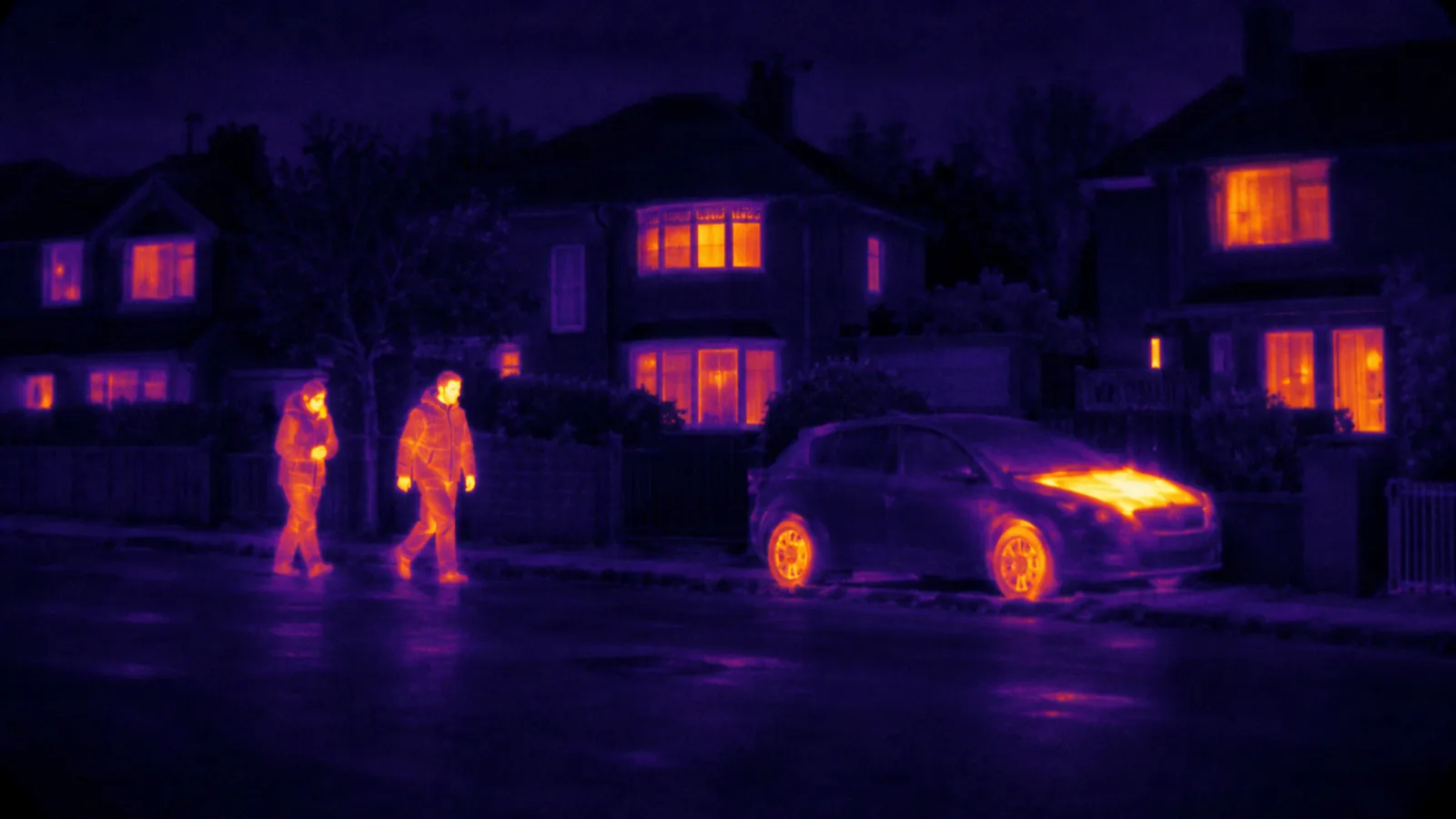
Thermal vision means seeing heat: the long-wave infrared radiation that every object emits simply because it has a temperature, rather than the visible light bouncing off it. A thermal camera needs no lamp, no flash and no moonlight, because the subject is its own source.
That one difference explains almost everything else about it — what it is superb at, what it is useless at, and why it costs what it does.
Light you reflect, light you emit
Your eye and an ordinary camera work on reflected light. Switch off the lamp and the scene disappears, because there is nothing left to bounce.
Everything warmer than absolute zero also emits radiation, and the warmer it is, the more it emits and the shorter the wavelengths. A star at 5,800 K peaks in visible light, which is why you can see it. A person at 310 K peaks around 9.5 micrometres — deep in the infrared, invisible to you and to your phone.
Thermal vision is a sensor built for that band, typically 8 to 14 micrometres. Point it at a dark room and the room is still there, drawn entirely by its own warmth.
What it actually looks like
Not like a photograph. A thermal image is a grid of temperature readings painted in false colour — a legend, not a picture. Warm reads bright or orange, cold reads dark or blue, depending on the palette you choose.
Resolution is low by photographic standards: a handheld imager is typically 160×120 or 320×240 pixels, next to the 48 megapixels in a phone. You can see instantly that something warm is there. You often cannot tell what it is.
And contrast depends on temperature difference, not on lighting. On a frosty night a person in a field is unmissable. On a hot afternoon, when the ground has warmed to skin temperature, the same person can nearly vanish.
Thermal vision is not night vision
This is the single most common mix-up, and the two technologies fail in opposite conditions:
- Night vision amplifies the small amount of visible and near-infrared light already present. It gives you a recognisable scene — faces, signs, terrain — but it needs some light, and it is defeated by total darkness, fog and smoke.
- Thermal senses emitted heat. It works in absolute darkness and sees through smoke, dust and light fog. It cannot read a sign, recognise a face, or see through a window.
We wrote the full comparison in night vision vs thermal.
Where it earns its keep
- Buildings. Missing insulation, a draught round a window frame, damp inside a wall, the path of underfloor heating. This is the job nothing else does.
- Electrical inspection. A loose connection heats up long before it fails, so a thermal sweep of a distribution board finds tomorrow’s fault today.
- Mechanical. Bearings, brakes, over-worked motors, blocked radiators.
- Search, rescue and wildlife. A warm body against cold ground is the clearest signal in either technology.
- Firefighting. Through smoke, thermal is the only thing that works, which is why every modern crew carries one.
Four things it genuinely cannot do
See through walls. It sees the surface of the wall. A warm pipe behind the plaster shows up only because it slowly warms the plaster above it — blurred, delayed and faint.
See through glass. Glass is opaque at these wavelengths and behaves like a mirror. Point a thermal camera at a window and you photograph yourself.
Measure a shiny surface. Polished metal reflects infrared, so it reads as whatever it is reflecting. Thermographers stick a square of matt tape on and measure that instead.
Run on a phone without hardware. Your phone has no microbolometer, so no app can do this. See does the iPhone have a thermal camera.
So what is a thermal camera app?
It is the last step of the chain without the first three. A real imager measures temperature and then paints those numbers in false colour. An app skips straight to the painting: it takes the brightness of your ordinary camera picture and runs it through the same palettes — iron, rainbow, arctic.
Where brightness and heat happen to line up, the result is convincing: steam off a mug, a hot laptop vent, sunlight through a curtain. Where they do not, it is simply a colour effect, and any app that tells you it measures temperature is lying.
Thermal Camera is the honest version of that: twenty looks rendered live on the device, a HUD that marks the brightest and darkest parts of the frame, and no temperature values anywhere, because your iPhone cannot produce one.