
Comparison
Infrared vs thermal camera: are they the same thing?
Every thermal camera is an infrared camera, but most things sold as infrared cameras see reflected near-infrared light, not heat. Here is how to tell them apart.
Updated
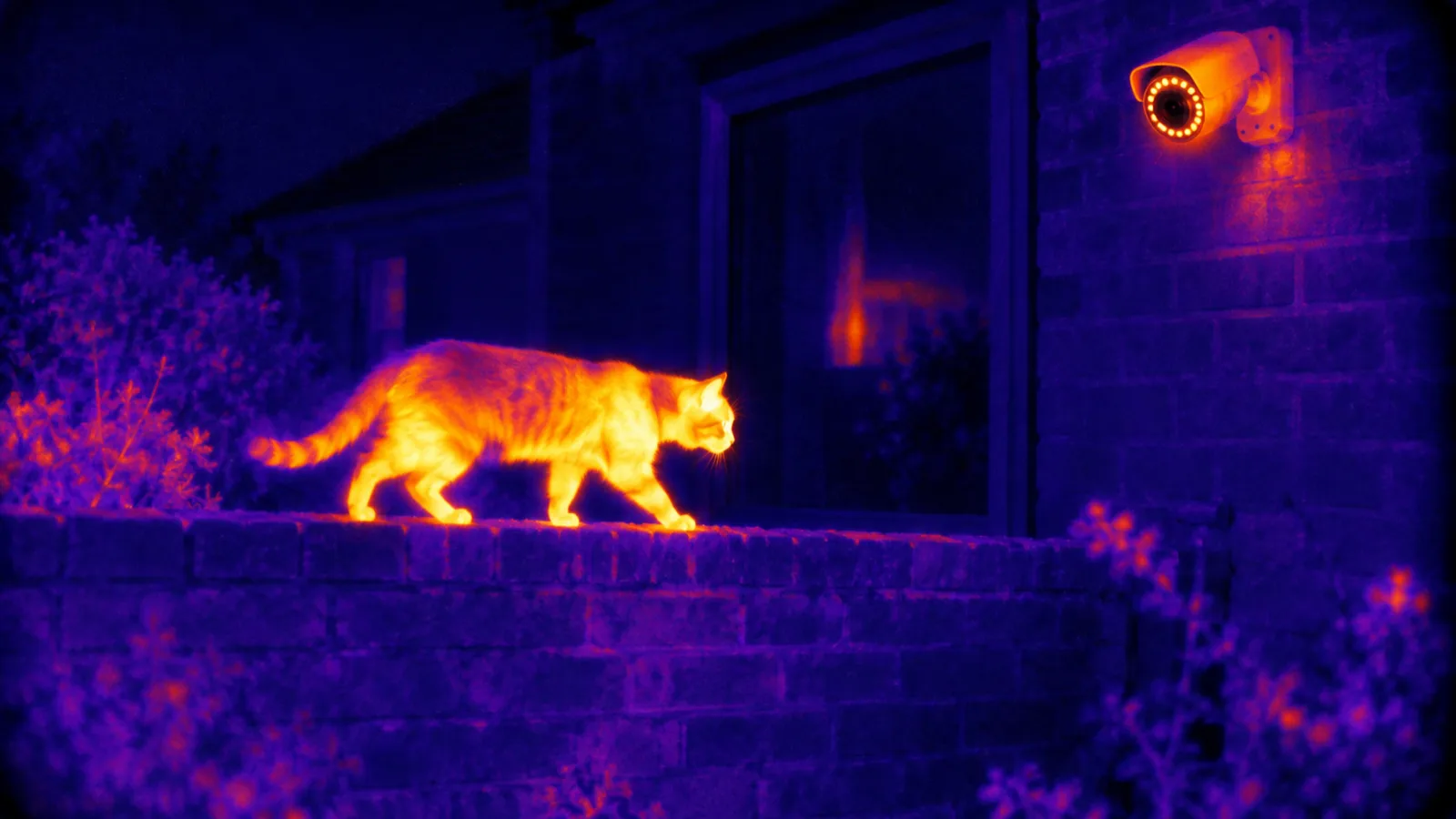
Every thermal camera is an infrared camera, but most things sold as “infrared cameras” are not thermal cameras. Security cameras, trail cameras and baby monitors with “infrared night vision” are ordinary cameras that see near-infrared light bounced off the scene by their own infrared lamps. A thermal camera senses heat that objects give off themselves, needs no lamp at all, and is built from completely different parts.
The confusion is a word problem. “Infrared” is not one thing; it is a stretch of the spectrum many times wider than visible light, and the two ends behave nothing alike.
The infrared bands
Infrared starts just past visible red, around 0.75 micrometres (µm), and runs out to the tens of micrometres. The boundaries differ a little from source to source, but the usual split is:
- Near infrared (NIR), about 0.75–1.4 µm. Behaves like light: it reflects off surfaces, and a warm object at room temperature emits almost none of it.
- Short-wave infrared (SWIR), about 1.4–3 µm. Still mostly reflected light. Used in industry and science, with special InGaAs sensors.
- Mid-wave infrared (MWIR), about 3–5 µm. Emitted heat. Used by cooled, high-end thermal cameras.
- Long-wave infrared (LWIR), about 8–14 µm. Emitted heat from things at everyday temperatures, which is where consumer thermal cameras work.
The rule of thumb: the near end is reflected light, the far end is emitted heat. “Infrared camera” can mean either.
What an ordinary camera sees
Phone and security camera sensors are made of silicon, which responds to light up to roughly 1.0–1.1 µm. That covers visible light and a slice of near infrared, and nothing beyond.
Because near infrared would wash out the colours of a daytime picture, cameras put an IR-cut filter in front of the sensor. A day/night security camera physically moves that filter aside when it gets dark (the faint click you sometimes hear), switches to black and white, and turns on its infrared illuminator: a ring of LEDs at 850 nm, which glows faintly red if you look straight at it, or 940 nm, which is close to invisible but gives the camera less light to work with.
So the “infrared night vision” camera is really a camera with a torch you cannot see. A warm person and a cold statue look the same to it. If you want the comparison with image-intensifier night vision, it is in night vision vs thermal.
What a thermal camera sees
A thermal camera does not need a lamp, because at 8–14 µm the scene is its own light source. Its sensor is usually a microbolometer: a grid of tiny membranes that warm up slightly when infrared hits them, changing their electrical resistance. One membrane, one pixel. The full chain is in how does a thermal camera work?
The lens is the giveaway. Ordinary glass is opaque at long-wave infrared, so thermal lenses are made of germanium, which looks like dark polished metal to your eye and is clear to the sensor. It is also why a thermal camera cannot see through a window: it shows you the glass, and the reflection of whatever is on your side of it.
A quick test: which one do you have?
- Look at the lens. Clear glass with a ring of small dark-red LEDs around it means near infrared. A dark, mirror-like grey or gold lens with no LEDs suggests thermal.
- Point it at a window from indoors at night. If it shows the garden, it is near infrared. If it shows a flat panel, or your own warm reflection, it is thermal.
- Put your hand on a table for ten seconds, then lift it. A thermal camera shows a glowing handprint that fades over a minute or so. A near-infrared camera shows a table.
- Check the price and resolution. A cheap camera with a sharp 1080p or 4K night picture is near infrared. Thermal sensors are usually somewhere between 80×60 and 640×480 pixels, and they cost far more per pixel; see how much a thermal camera costs.
Which do you need?
- To see who is at the door, watch a baby or check a driveway at night: a near-infrared camera. You need faces and detail, and it is cheap.
- To find a draught, a damp patch, a hot electrical connection or an animal in the dark: thermal. Near infrared cannot show temperature at all.
- For wildlife: often both — thermal to spot an animal, near infrared or ordinary night vision to see what it is.
And your phone?
Phones do have near-infrared parts: Face ID’s flood illuminator and dot projector, the proximity sensor beside the earpiece, and a camera sensor that can catch a TV remote flashing. What they do not have is a thermal sensor. The details are in does your phone have infrared?
That is why our app, Thermal Camera, is honest about being a visual effect: it maps the brightness of the ordinary camera picture onto thermal palettes and measures nothing. For the look, it is good. For a temperature, you need real thermal hardware.
Related
- Night vision vs thermal — which one do you actually need?
- Can a thermal camera see through walls?
- Can I use my phone as a thermal camera?
Frequently asked questions
Is an infrared camera the same as a thermal camera?
Not usually. A thermal camera is a kind of infrared camera: it senses long-wave infrared, roughly 8 to 14 micrometres, which objects give off because they are warm. Most products sold simply as infrared cameras, such as security cameras, trail cameras and baby monitors, are ordinary silicon cameras that see near infrared, around 850 or 940 nanometres, reflected from their own infrared lamps. They show a black-and-white picture in the dark, not heat.
Can a night vision security camera see body heat?
No. A security camera's night mode lights the scene with infrared LEDs and records the light that bounces back. A warm person and a cold statue look the same to it. Seeing body heat takes a thermal sensor, usually a microbolometer behind a germanium lens.
Is my phone camera an infrared camera?
Only a little, and only in near infrared. Phone sensors are silicon, which responds up to about 1 micrometre, and an IR-cut filter blocks most of that. Phones also carry near-infrared parts such as Face ID's flood illuminator and dot projector. None of this senses heat: no ordinary phone has a thermal sensor.