Hardware
Does your phone have infrared?
The iPhone has infrared for Face ID, no emitter for controlling a TV, and no thermal sensor. Here is which infrared your phone has, and what you can reach.
Updated
Yes and no — and almost everyone asking wants one of the two things an iPhone cannot do. The short version:
- To control a TV, an air conditioner or a stereo: no. No iPhone has ever had an infrared emitter — a “blaster”.
- To take a heat picture: no. No iPhone has a thermal sensor.
- To unlock with your face: yes. Face ID uses infrared, and you cannot reach it.
- To check whether a remote still works: yes, and this one genuinely works. It is at the bottom.
Two infrareds, one word
Near infrared, roughly 0.7 to 1.4 micrometres, sits next to visible red. Ordinary camera sensors can see it. It is what remote controls transmit and what Face ID uses to map your face.
Long-wave infrared, roughly 8 to 14 micrometres, is what any object emits simply because it is warm. That is thermal imaging, and it needs a microbolometer behind a germanium lens. Silicon is blind to it.
Your phone has hardware for the first and none for the second.
Why there is no emitter
Apple never fitted one. It bet on the network instead: Wi-Fi, Bluetooth, HomeKit, AirPlay and the Apple TV remote in Control Centre. A connected device answers more reliably, needs no line of sight and works from another room.
That covers modern connected gear. It does not cover the 2014 air conditioner in the spare bedroom, which is why the question keeps getting asked.
Phones that still have one: most Xiaomi, Redmi and Poco models, several current Motorola, Realme and Infinix handsets. Samsung dropped it after the Galaxy S6. If it matters to you, it is a pre-purchase checklist item — no app adds hardware.
On an iPhone the answer is a dongle. Small infrared transmitters exist for USB-C and Lightning and ship with their own app. They work, they are cheap, and they are the only way to send an infrared command from an iPhone.
And the thermal half
No iPhone has a thermal sensor, and neither does any mainstream Android flagship. A few rugged phones carry one built in — currently the Doogee S300 Plus Thermal, Ulefone Armor 29 Pro Thermal and Blackview BL9000 Pro; the Cat S62 Pro is discontinued. The whole subject is in does the iPhone have a thermal camera.
The infrared trick your phone really can do
Worth knowing, because it is real and rarely mentioned.
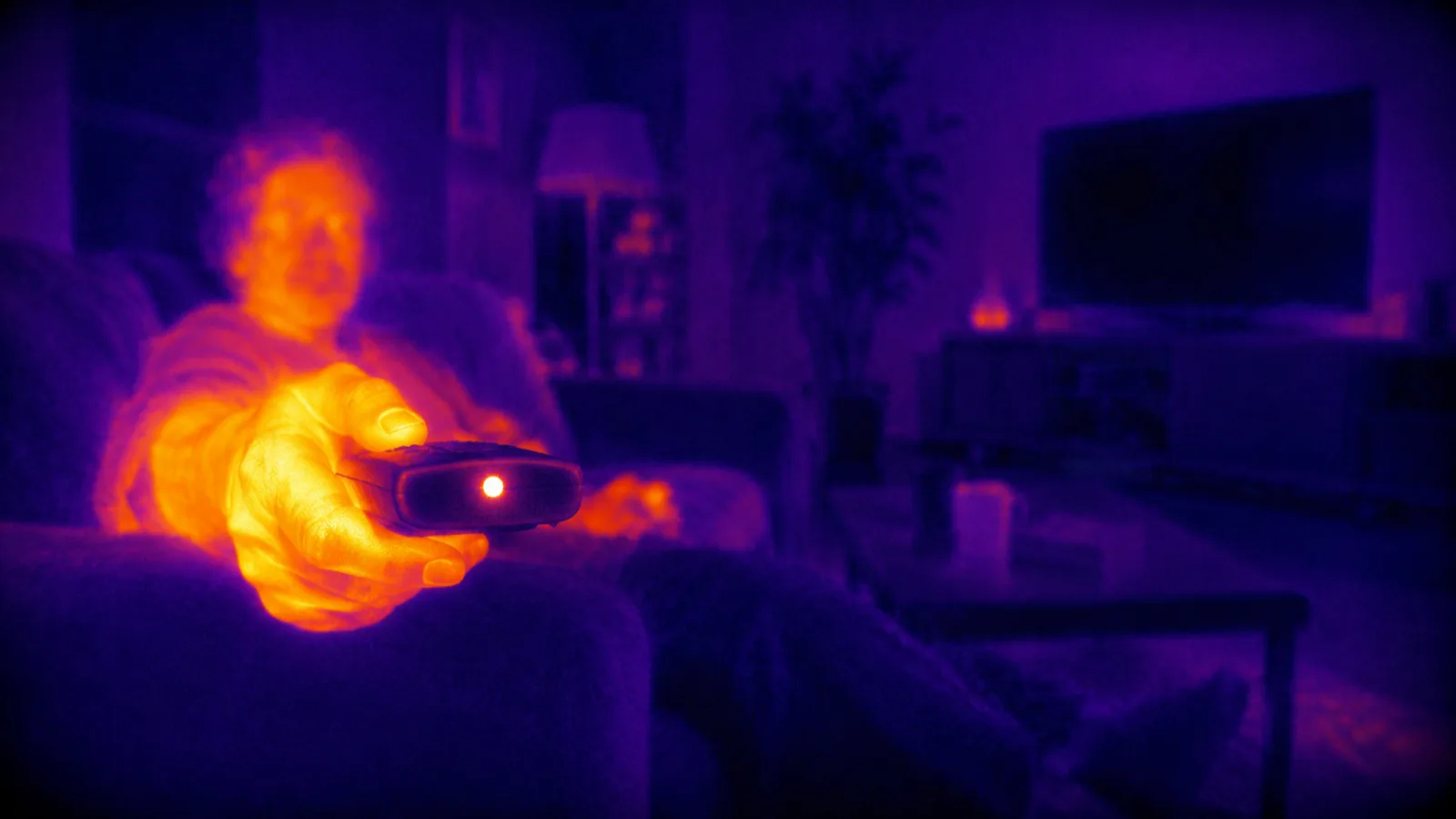
Most phone cameras keep some near-infrared sensitivity even with an IR-cut filter fitted. In a dark room, point your front camera at the tip of a remote control and press a button: on most phones the emitter shows up as a faint purple-white flicker that your eye cannot see at all.
That is genuine infrared detection, and it is the standard way to tell a dead remote from flat batteries. No app needed — the stock Camera app does it. Front cameras usually work better than rear ones, because their filtering tends to be weaker.
What it does not give you is heat. The LED glows because it is emitting near infrared, not because it is warm.
By model
True for the iPhone XR, 11, 12, 13, 14, 15, 16, 17 and everything before them, in every trim:
- Infrared emitter for controlling devices: no
- Thermal sensor: no
- Face ID infrared: yes, not accessible to apps
- LiDAR (Pro models): yes, measures distance, not temperature
- Seeing a remote through the camera: yes
Where our app fits
Thermal Camera is neither of the two things above: it is a camera effects app. It takes the ordinary picture and applies twenty thermal, night-vision and FX looks live, with a HUD, a detail overlay and video recording. It measures no temperature and controls no television — and we say so everywhere, because those two misunderstandings are exactly what fills the App Store with one-star reviews.