
Night vision
Who invented night vision?
No single person invented night vision. It grew from 1920s television research, wartime infrared sights and the Cold War tube generations. Here is the timeline.
Updated
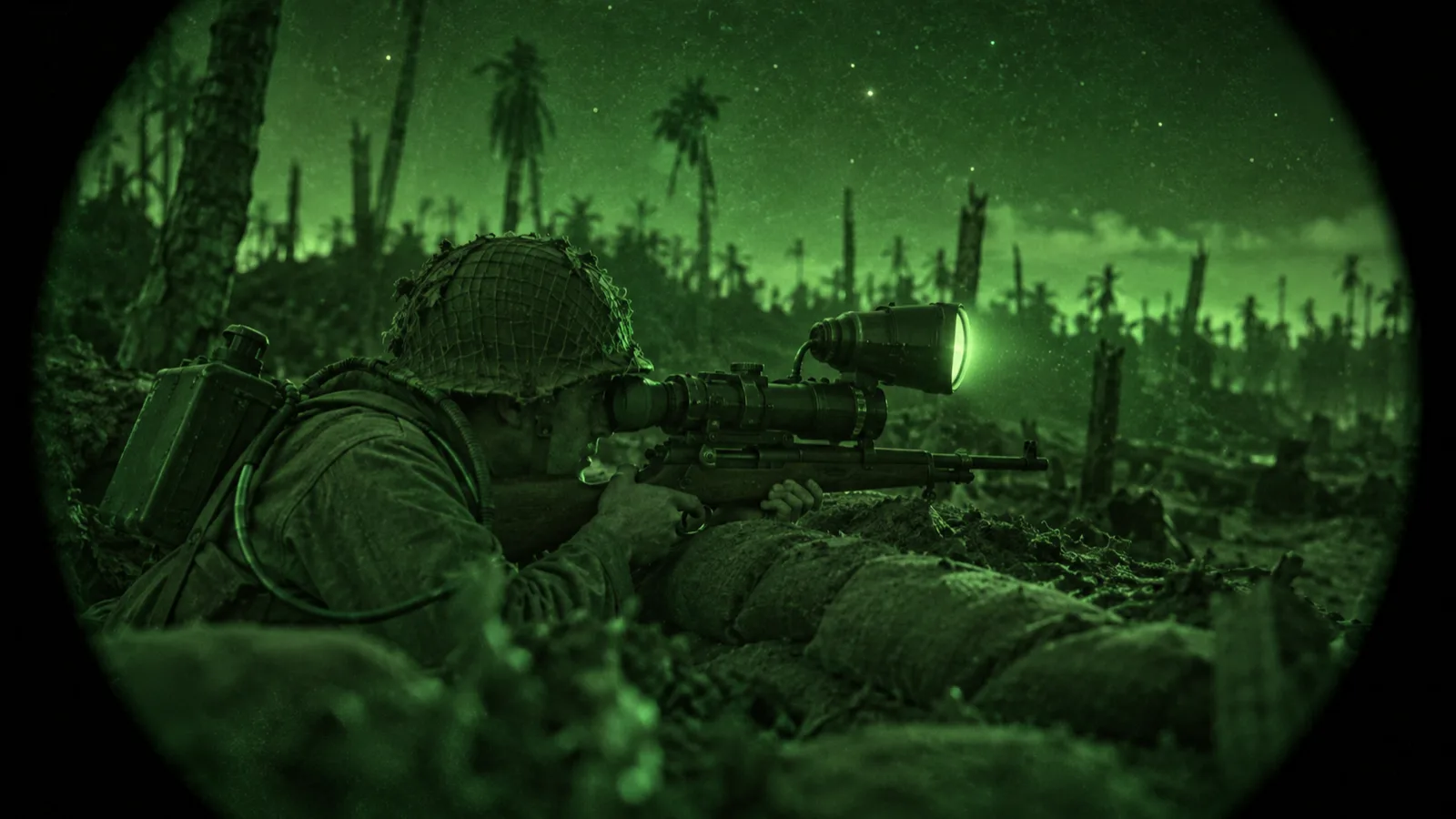
No single person invented night vision. It came together over about sixty years. Kálmán Tihanyi built an infrared-sensitive television camera for British air defence in 1929. Gilles Holst at Philips made the first working infrared converter tube in 1934. Germany and the United States took infrared sights into combat in 1944–45. The US Army developed the passive starlight scopes of the 1960s, and the tube generations that followed are the night vision people use today.
Before the war: television and a Dutch tube
Night vision began as a side branch of television. Tihanyi, a Hungarian engineer who had patented a charge-storage television tube in 1926, was working in London by the late 1920s on camera guidance for the British Air Ministry. In 1929 he built what is generally described as the first infrared-sensitive electronic television camera, intended for anti-aircraft defence. It turned invisible infrared into a picture, and every later device follows that basic idea.
In the Netherlands, Gilles Holst and Hendrik de Boer had proposed an “image tube” in 1928, but their first attempts failed. In 1934 Holst, at Philips, got one to work. Light focused onto a photocathode released electrons, several thousand volts pushed them onto a fluorescent screen, and the screen glowed with the image. For the first time infrared could be watched in real time. There was a catch: the tube barely amplified anything, so at night it needed its own infrared light source.
The war: Generation 0
That catch defined the first night-vision weapons. They were active: an infrared lamp lit up the target, and a converter tube showed the reflection. Today they are called Generation 0.
Germany got there first. AEG started work in the mid-1930s, and infrared sights were tested on Panther tanks from 1943. The best-known infantry device was the Zielgerät 1229, codenamed Vampir, an infrared sight and lamp for the StG 44 rifle. It went into limited service in February 1945. Accounts put production between about 200 and 310. The sight was light, but the batteries weighed more than 13 kg and were carried on a pack frame.
The United States answered with the M1 and later M3 Sniperscope, an infrared scope and lamp on an M1/M2 carbine, along with a handheld version called the Snooperscope. Development began in 1943, and it was first used in combat on Okinawa in 1945. Range was about 70 yards. Accounts disagree on how many reached the island, from about 150 to more than 500. Improved M3s were still in use in Korea.
Both had the same flaw. The lamp that let you see was a beacon to anyone else with a viewer.
The Cold War: three generations
Generation 1 (1960s). The US Army’s night vision laboratory dropped the lamp. Its Starlight scopes, such as the AN/PVS-2 used in Vietnam, chained three intensifier stages together to amplify starlight and moonlight about a thousand times. They were passive, so they gave nothing away, but they were bulky and worked best with some moonlight.
Generation 2 (1970s). The microchannel plate replaced the chain of tubes with a single glass disc full of microscopic channels that multiply electrons. Tubes became small and light enough for goggles. The tube itself is explained in how do night vision goggles work.
Generation 3 (1980s). A gallium arsenide photocathode, developed in the 1970s and in production through the 1980s, made tubes much more sensitive, especially in near infrared. Gen 3 became the standard for US and allied forces in devices like the AN/PVS-7 and AN/PVS-14, and it still is. The green screen is another legacy of these tubes; the reason is in why is night vision green.
Thermal imaging: a separate history
Thermal cameras get called night vision, but they sense heat, not light, and come from a different line. William Herschel discovered infrared in 1800 by putting a thermometer past the red end of a spectrum. In 1840 his son John made the first crude heat pictures from the uneven evaporation of a thin film. Sources disagree on exactly how he recorded them. Samuel Langley’s bolometer followed in 1880.
Imaging came much later. Texas Instruments built the first forward-looking infrared (FLIR) camera in the early 1960s, with production from 1966. A commercial thermal camera for power-line inspection went on sale around 1965. Uncooled sensors became cheap in the late 1990s, which is why thermal cameras now come in pocket sizes. The physics is in how does a thermal camera work.
Today: digital, and a filter
The newest branch skips the tube. Digital night vision uses a very sensitive camera sensor, usually with an infrared illuminator, so in principle it is active again, much like Vampir, only small and cheap. Trail cameras and security cameras work this way.
A century after Tihanyi, the look has become something your phone can copy. Thermal Camera by App Department has green and amber night-vision looks that recreate the phosphor glow, grain and vignette on your live camera picture. It is a filter: it amplifies no light and measures nothing. It just shows you what the history looked like.
Related
Frequently asked questions
Who invented night vision?
No single person. Kálmán Tihanyi built an infrared-sensitive television camera for British air defence in 1929, Gilles Holst at Philips made the first working infrared image converter tube in 1934, and German and American engineers turned the idea into weapon sights during the Second World War. The passive night vision most people picture came later, from the US Army in the 1960s.
When were night vision goggles invented?
The first infrared viewers were used in combat in 1945, but they needed a big infrared lamp and were mounted on rifles, not worn. Passive starlight scopes followed in the 1960s, and the microchannel plate of the 1970s made tubes small and light enough for head-mounted goggles. Gallium arsenide Gen 3 tubes went into production in the 1980s.
Is thermal imaging the same invention as night vision?
No. Thermal imaging senses heat rather than amplifying light and has its own history, from William Herschel's discovery of infrared in 1800 to the first forward-looking infrared camera at Texas Instruments in the early 1960s and cheap uncooled sensors from the late 1990s.