
Buying
How much do night vision goggles cost?
Night vision runs from under $100 for a digital monocular to well over $8,000 for Gen 3 goggles. The tube inside sets the price; here is what each band buys.
Updated
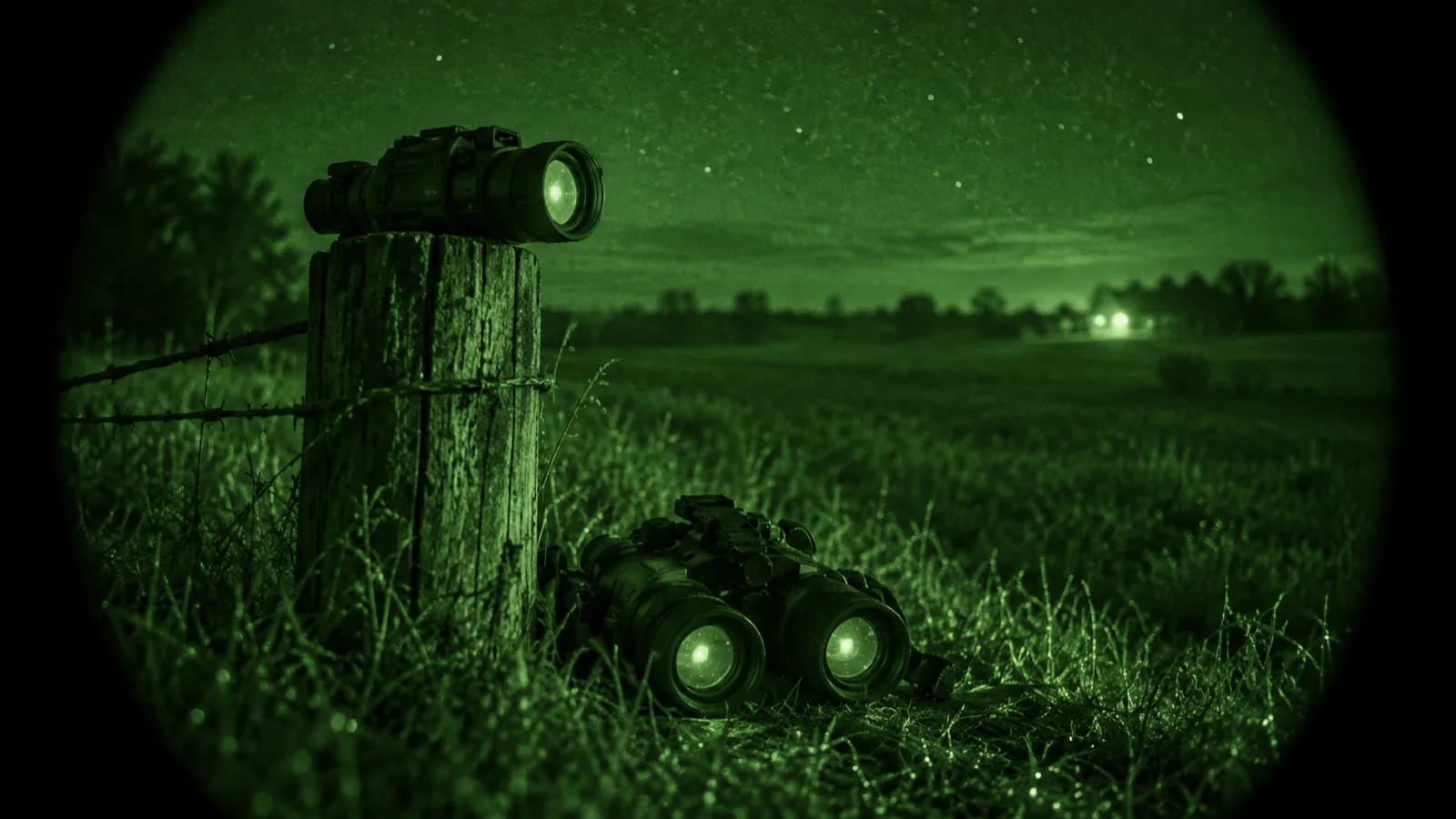
Night vision goggles cost anything from under $100 to well over $8,000, and almost all of that spread comes from one part: the image intensifier tube. A digital monocular with a camera sensor and an infrared lamp sits at the bottom. A pair of goggles with two Gen 3 tubes sits at the top, and every band in between is mostly a better tube.
The figures below are rough, in US dollars, for new devices from reputable sellers. Dealer prices move often, so treat them as bands, not quotes.
Digital night vision: under $100 to a few hundred dollars
Not a tube at all. A sensitive CMOS camera sensor, the same family of chip as in a phone, with the infrared filter removed and an infrared LED illuminator, usually at 850 nanometres, shining into the dark. The picture goes to a small screen behind the eyepiece.
The cheapest monoculars sell for well under $100; binoculars with a better sensor and a stronger illuminator run into the low hundreds. They record video easily and survive daylight. The limit is the illuminator: beyond its reach you see very little, and anyone else with night vision sees your lamp.
Gen 1: a few hundred dollars
The first real intensifier tubes, 1960s technology still made cheaply. Expect roughly $200 to $600. The image is soft at the edges, noisy and dim under starlight alone, so most Gen 1 devices also carry an infrared illuminator. Fine for a garden or a campsite; not what people mean by “military night vision”. How the tube works is in how do night vision goggles work?
Gen 2 and Gen 2+: about $2,000 to $3,500
Gen 2 adds the microchannel plate, a glass disc full of microscopic channels that multiply each electron thousands of times. That is the jump from “dim” to “usable under starlight”. Modern Gen 2+ tubes, mostly made in Europe, get close to Gen 3 performance and are sold as free of US export rules. A complete monocular built around one typically costs about $2,000 to $3,500 at current dealer prices.
Gen 3: about $3,000 to $4,500 for one tube
Gen 3 tubes use a gallium arsenide photocathode, which turns more of the faint incoming light into electrons, and they last thousands of hours. They are made in the United States and controlled under ITAR, the US arms export rules, so dealers can usually ship them only inside the US. A Gen 3 monocular in the classic PVS-14 style runs roughly $3,000 to $4,500 depending on the grade of tube, measured by its figure of merit.
White phosphor or green
The tube’s screen can glow green or white-grey. White phosphor, popular on newer high-grade tubes, gives a black-and-white image many users find easier over a long night, and it usually costs a few hundred dollars more than the same tube in green. Why the classic colour is green is in why is night vision green?
One tube or two
A monocular has one tube; real goggles, or binoculars with two tubes, have one per eye. Two tubes give you depth perception, and since the tube is the expensive part, they roughly double the price. Gen 3 goggles with two tubes usually start around $8,000, and premium white phosphor models go well past $10,000. Cheap “binoculars” that cost the same as a monocular are almost always one tube, or one sensor, split to both eyes.
Why it costs so much
The tube is a small vacuum device built by hand in a few factories worldwide. The photocathode has to be grown on glass in an ultra-clean vacuum, the microchannel plate holds millions of channels a few microns wide, and the screen has to be flawless. Many tubes fail grading and are sold cheaper or scrapped. Volumes are tiny next to camera sensors, the main buyer is the military, and export rules shrink the civilian market further. None of that gets cheaper with scale the way phone cameras did.
The cheaper answer: rent, or borrow
If you need night vision for one trip, one night of wildlife watching or one event, renting is the honest option. Some specialist dealers and training schools hire out tube devices, and for a single outing that costs a fraction of buying. A digital monocular is the low-cost purchase if you will use it often and only at short range.
And the free option
An app does not belong in these bands. A phone camera has no image intensifier, so in real darkness it sees little or nothing, and no app changes that. What an app can do is give an ordinary picture the green, grainy look of a tube.
Thermal Camera does that, among its other looks, and says so plainly: it is an effect for photos and video, and it amplifies and measures nothing. If you actually need to see in the dark, use one of the bands above. And if what you need is to see heat rather than light, that is a different device; the difference is in night vision vs thermal.
Related
Frequently asked questions
How much do night vision goggles cost?
It depends on what is inside. Digital night vision, a camera sensor with an infrared lamp, costs from under $100 to a few hundred dollars. Gen 1 tube devices run a few hundred dollars. Gen 2 and Gen 2+ monoculars are roughly $2,000 to $3,500, Gen 3 monoculars roughly $3,000 to $4,500, and Gen 3 goggles with two tubes usually start around $8,000. Prices change often, so check current dealer listings.
Why is night vision so expensive?
Because the image intensifier tube is hard to make. Its photocathode, microchannel plate and phosphor screen are built in a vacuum by a handful of factories, many tubes fail testing, and volumes are small. Gen 3 tubes are also export-controlled in the US, which limits who can buy them and keeps the market narrow. Two-tube goggles need two of those tubes, so they cost roughly twice as much.
Can my phone be used as night vision goggles?
No. A phone camera has no image intensifier, so it cannot amplify starlight the way a night vision tube does; in real darkness it sees little or nothing. Apps can give a picture the green night-vision look, which is fun for photos and video, but they do not make the camera see any better in the dark.