
Night vision
Do night vision glasses really work?
Yellow 'night vision' driving glasses do not help you see at night. A tinted lens can only remove light. Here is what the research found, and what actually helps.
Updated
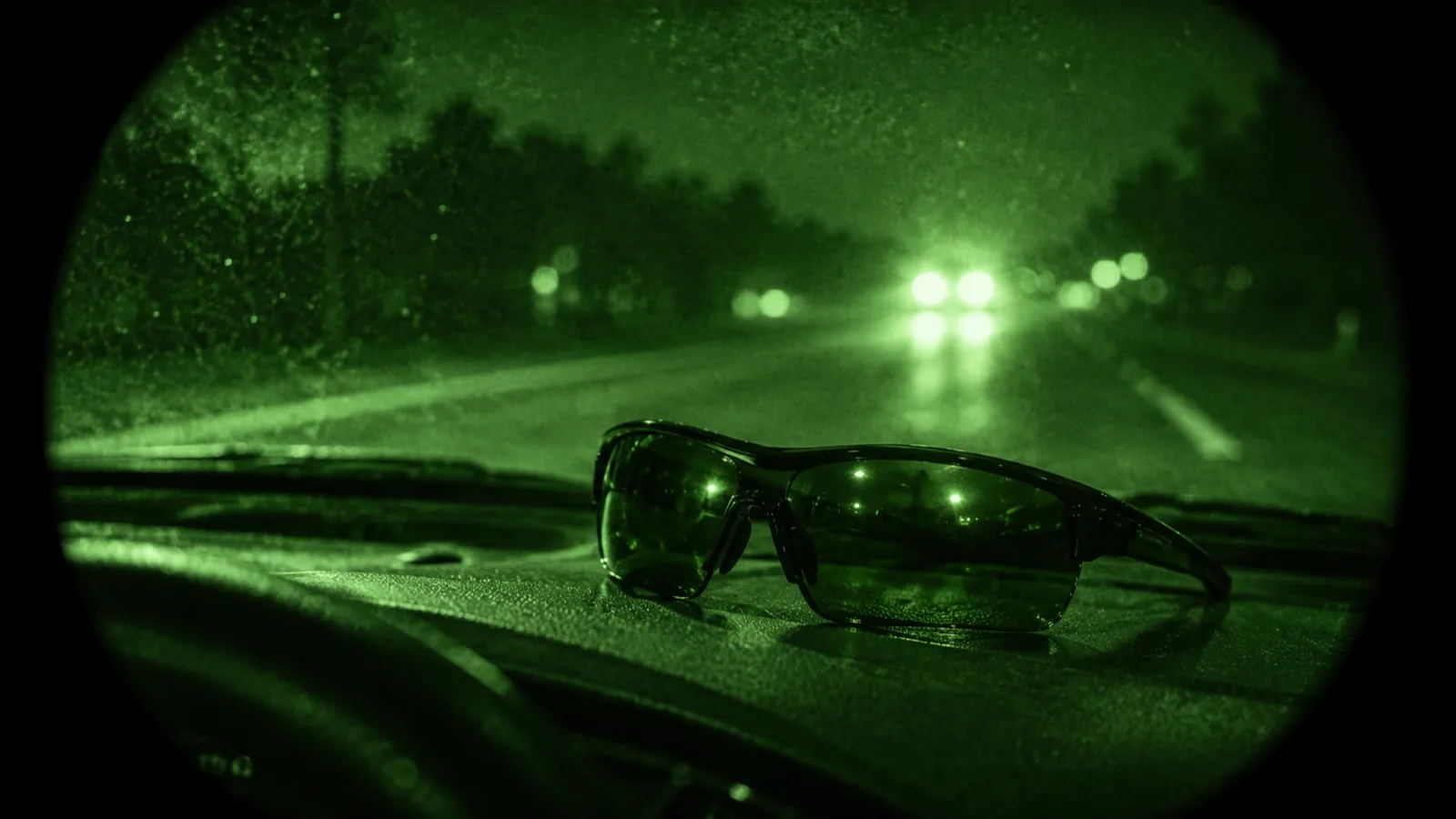
No. “Night vision glasses” do not improve your night vision. They are tinted lenses, usually yellow or amber, and a tint can only take light away. A 2019 driving-simulator study found they did not help drivers see pedestrians, with or without headlight glare. Eye-care bodies in the US and UK advise against them for night driving.
What these glasses are
Search for night vision glasses online and you will find cheap wraparound frames with yellow or amber lenses. They are sold for night driving and promise less glare from headlights, streetlights and signs. Some clip over normal glasses.
Despite the name, there is nothing inside them. No sensor, no battery, no electronics. They are coloured plastic or glass, a filter that blocks part of the light, mostly blue. That is useful in some daytime settings. The trouble starts when the sun goes down.
What the research found
The clearest test is a study by Alex Hwang, Merve Tuccar-Burak and Eli Peli at the Schepens Eye Research Institute (Massachusetts Eye and Ear, Harvard Medical School). It was published in JAMA Ophthalmology in 2019.
They put 22 adults with normal vision in a driving simulator. Each person drove with three commercially available yellow-lens glasses and with clear lenses. The task was simple: press a button as soon as you see a pedestrian walking along or crossing the road. Some drives had simulated glare from oncoming headlights.
The results:
- The yellow lenses did not help drivers spot pedestrians sooner than clear lenses.
- They did not reduce the harm done by headlight glare.
- There was no meaningful difference between the three brands.
- Headlight glare slowed everyone down, and older drivers were slowed much more than younger ones. The glasses did not help either group.
Hwang said the yellow lenses may even have made performance slightly worse, though the difference was not statistically significant. He compared them to wearing sunglasses at night. Participants often said things looked brighter through the yellow lenses, which may explain why people keep buying them. Feeling that you see better while not seeing better is its own risk.
Why a tint cannot help at night
The physics is short. Any coloured lens works by absorbing part of the light. Clear lenses let through the most. A yellow lens removes some blue, and amber removes more. So the eye always receives less light through a tinted lens than through a clear one.
In daylight there is plenty of light to spare, so cutting some can make you more comfortable. At night, the eye is already working with very little. Removing more makes dark parts of the road darker, and that is where a pedestrian in dark clothes is.
The American Academy of Ophthalmology has published the same view. Its article on the subject quotes ophthalmologist Andrew Iwach, who said tinted or polarized lenses limit the light reaching the eye, which can make night driving harder. In the UK, the College of Optometrists told drivers in 2023 to avoid yellow filters because they are not proven to help and may even be dangerous. The UK Highway Code (rule 94) says that at night or in poor visibility you should not use tinted glasses, lenses or visors if they restrict your vision.
Anti-reflection coating is a different thing
People often mix up a tint with an anti-reflection coating. They do opposite jobs. A tint absorbs light. An anti-reflection coating is a thin clear layer that cuts reflections on the lens surfaces, so more light passes through and stray bright spots from headlights are reduced.
The College of Optometrists suggests it as one option for drivers who already wear glasses: it can reduce distracting reflections without making the road look darker. It is not night vision either. It only removes a problem that the lenses themselves create, so it does nothing for someone who does not wear glasses.
What actually helps
The advice from the AAO and the College of Optometrists is plain and cheap:
- Clean the windscreen, inside and out. A film on the inside of the glass scatters headlight glare. Check your wipers too.
- Clean your headlights and check their aim. Dirty lamps light the road less. Headlights aimed too high dazzle other drivers, and aimed too low leave your own lane underlit. Loads, lifts and tyre changes can shift the aim.
- Keep your glasses clean and your prescription up to date. An old prescription can make night driving much harder than it needs to be.
- Get an eye exam if night driving has become harder. Glare and halos can come from cataracts, dry eye, astigmatism and other conditions. Many of these can be treated, and no pair of glasses from a web shop will find them.
Real night vision is a different machine
The word “night vision” on these glasses borrows from a real technology. Real night vision goggles use an image intensifier tube. A photocathode turns the faint light that reaches it into electrons, a microchannel plate multiplies them, and a phosphor screen turns them back into a bright green image. It adds light to what you see. A tinted lens can only subtract it. The tube is explained in how do night vision goggles work, and the reason the picture is green is in why is night vision green.
Thermal imaging is different again. A thermal camera does not use visible light at all. It senses the heat that people, animals and engines give off, so it works in total darkness. Some cars offer it as a driver aid for exactly that reason. The comparison is in night vision vs thermal.
So there are three very different things that share a name. Real night vision amplifies light. Thermal sees heat. “Night vision glasses” are a filter.
An honest filter
Our own app is a filter too, and says so. Thermal Camera by App Department has green and amber night-vision looks that recreate the phosphor glow, grain and vignette on your live camera picture. It amplifies no light and measures nothing. It just shows you what the real thing looks like, which is more than a pair of yellow glasses can promise.
Related
- What is night vision?
- How do night vision goggles work?
- Night vision vs thermal
- Who invented night vision?
Frequently asked questions
Do night vision glasses really work for driving?
No. A 2019 driving-simulator study in JAMA Ophthalmology, from the Schepens Eye Research Institute, tested three brands of yellow-lens night driving glasses against clear lenses. None helped drivers spot pedestrians sooner, and none reduced the effect of oncoming headlight glare. A tinted lens can only remove light, and at night you need all the light you can get.
Why do yellow glasses seem to make things brighter at night?
It is a perception, not a measurement. Yellow lenses block some blue light and can make a scene look sharper or brighter, and people in the 2019 study said the same. But their reaction times did not improve. Every tint lets less light through than a clear lens, so the eye actually receives less.
What actually helps with night driving glare?
Clean the windscreen inside and out, and keep your glasses clean. Check your wipers and headlights, including headlight aim. Keep your prescription up to date, and if you wear glasses to drive, ask about an anti-reflection coating on clear lenses. If night driving has got harder, see an eye doctor, because cataracts, dry eye and other conditions can cause glare.