
Night vision
What is night vision, and what does it actually look like?
Night vision amplifies the light already there and shows it on a phosphor screen. Here is what that looks like in practice — and why film gets it wrong.
Updated
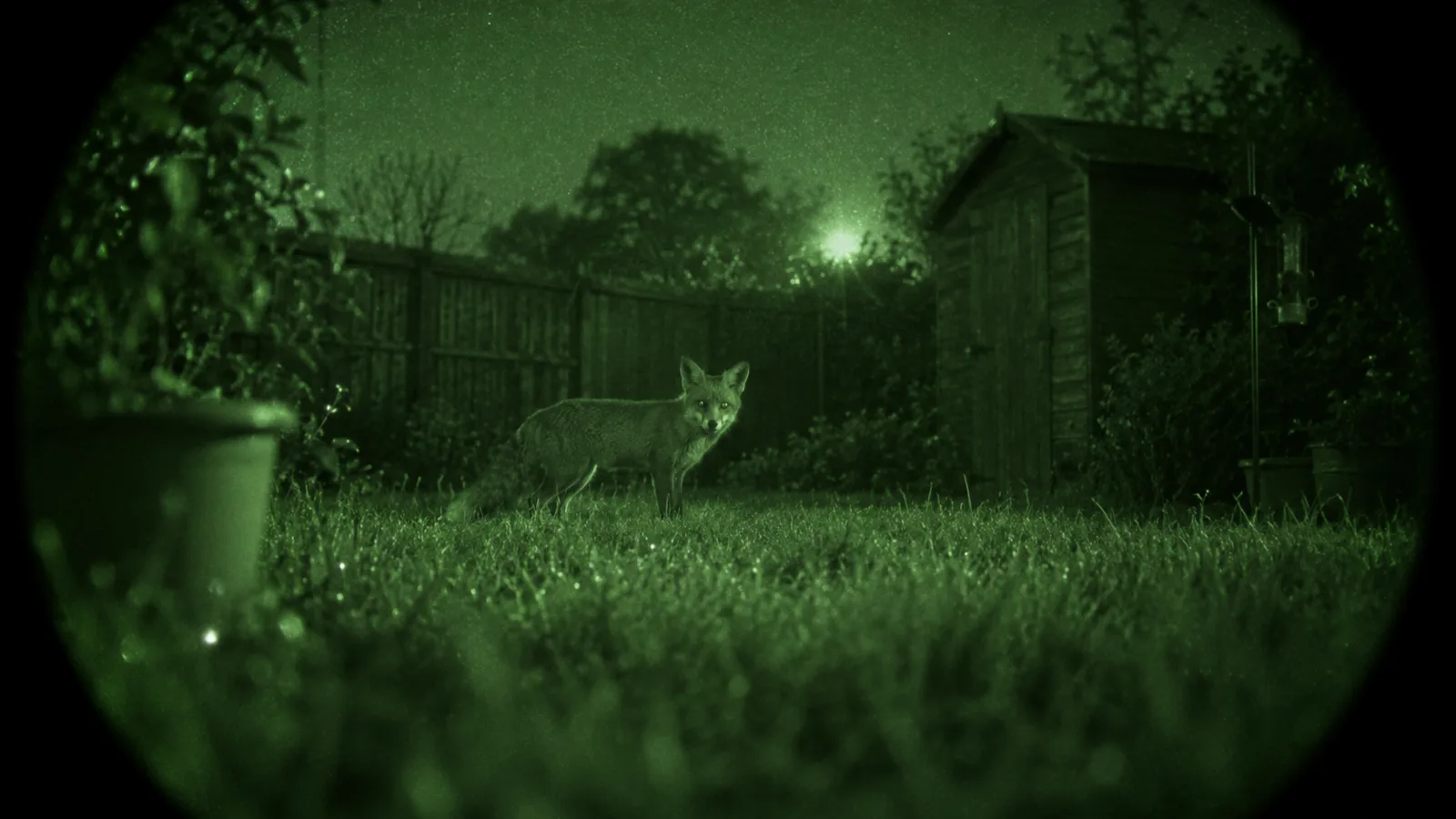
Night vision is any technology that lets you see in low light by amplifying the light already present. It does not create light and it does not sense heat. What you get is a monochrome, grainy, strangely flat version of the world — recognisable, but nothing like a photograph.
What you actually see
Films get this wrong in a specific way: they show a clean green picture with normal depth and normal contrast. The real thing has four features you notice immediately.
Grain that moves. The image sparkles. Every bright dot is a burst of electrons hitting the phosphor, and at low light levels you can see individual events. It looks like static laid over the scene, and it gets heavier the darker it is.
Bloom around bright things. A street lamp, a car headlight, a phone screen — each blows out into a halo far larger than the object. On older tubes a bright source can wash out the whole frame.
Flatness. With no colour and very compressed tonal range, depth cues collapse. Judging distance through night vision is genuinely difficult, which is why people who use it professionally train for it.
A circular frame. You are looking at a round screen through an eyepiece, so the world arrives as a bright circle in blackness.
Why it is green
Because the phosphor screen at the end of the tube is green, and green was chosen because the human eye resolves more detail in green than in any other colour at low brightness. Newer tubes use a white phosphor instead and produce a grey image that many users find easier over a long night.
The full version is in why is night vision green.
The three kinds
Image intensifiers. The classic tube: photocathode, microchannel plate, phosphor screen. No processor, no lag, and it needs at least some ambient light — starlight is enough, a sealed basement is not.
Digital night vision. A very sensitive sensor, usually with the infrared cut filter removed, often paired with an infrared illuminator at 850 or 940 nanometres. Cheaper, records video easily, and the illuminator is visible to anyone else with night vision.
Thermal. Not night vision at all, though it gets called that. It senses emitted heat rather than reflected light, works in total darkness, and shows you a heat map rather than a scene. The comparison is in night vision vs thermal.
What it cannot do
- Work in absolute darkness. No photons, nothing to amplify. Anything that claims otherwise is using an illuminator or is thermal.
- See through fog or smoke. Particles scatter the light it depends on.
- Show colour. The photocathode counts photons; it does not sort them by wavelength. Colour night vision exists in a few digital devices and is largely reconstructed rather than sensed.
- Run on a stock phone. No phone amplifies photons. A phone can lift a dim scene and tint it, which is useful in a dark room and does nothing in a dark cellar.
The phone version, honestly
The night looks in Thermal Camera reproduce what is described above deliberately: the green or amber phosphor grade, the grain, the vignette, the bloom on bright points. It is a filter on a live camera, applied in real time, and it is labelled as one.
If you want to know what the world looks like through a tube, it will show you convincingly. If you want to see in the dark, you need the tube.