
How to
Finding draughts, damp and missing insulation with thermal imaging
Thermal imaging is the one job where nothing else comes close — but only in the right conditions. When to survey, and what each pattern really means.
Updated
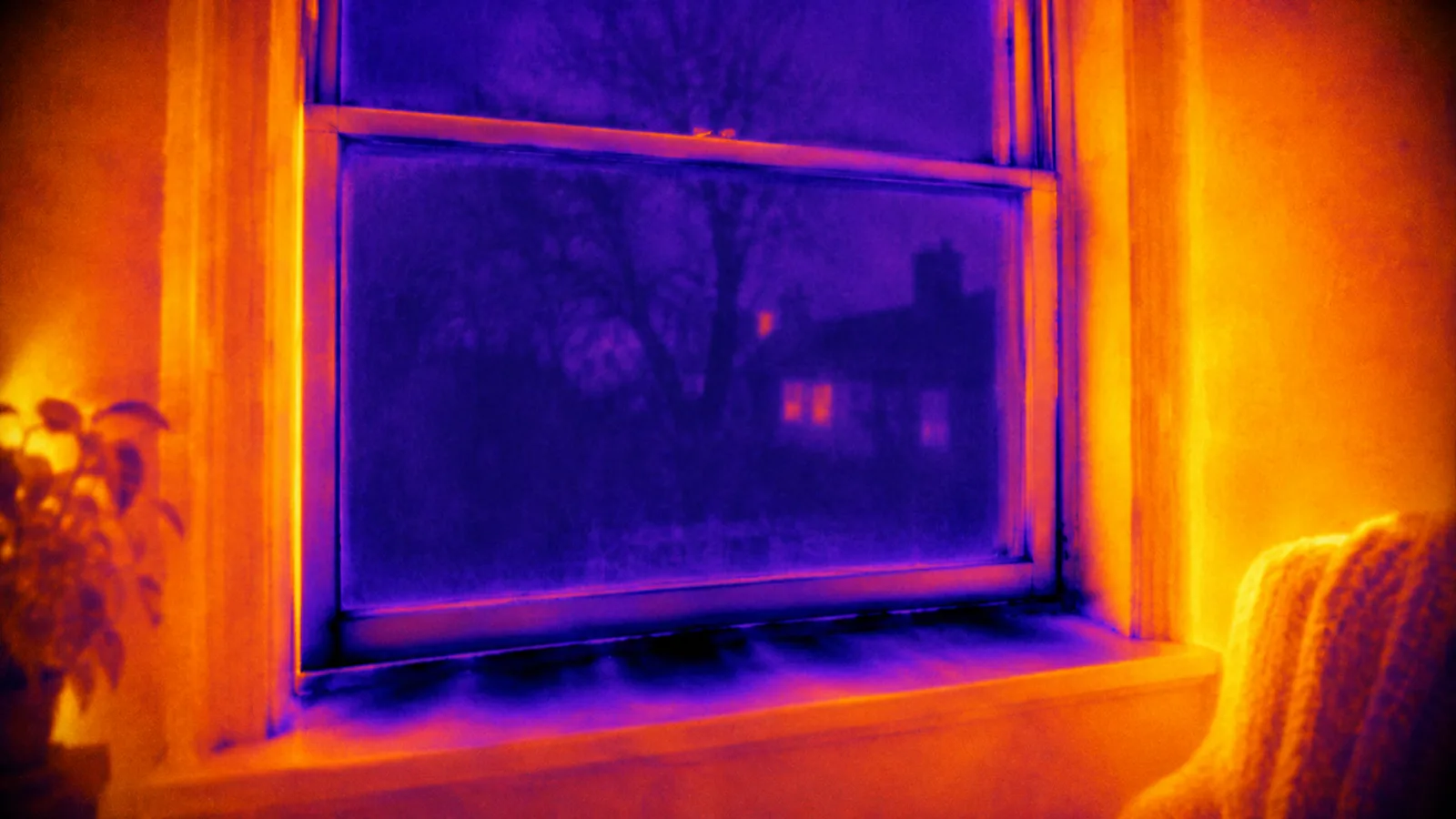
Finding where a house leaks heat is the job thermal imaging was made for, and it is also the job people most often do wrong. Not because the equipment is hard, but because they survey at the wrong time and read reflections as findings.
Get the conditions right, or do not bother
Thermal imaging shows temperature differences. No difference, no image. Which means:
- At least 10 °C between inside and outside. Fifteen is better. In a mild autumn you will see almost nothing.
- Heating on for several hours first. The building needs to be warm all the way through, not just the air.
- Before sunrise, or well after sunset. Sun on a wall during the day loads it with heat that takes hours to release, and everything you see afterwards is that, not the building.
- No rain, no strong wind. Wet walls evaporate and read cold everywhere; wind strips heat off the surface unevenly.
A winter morning an hour before dawn, after a cold night with the heating on, is the ideal survey. This is exactly what professionals do, and it is why a survey in July tells you nothing.
Survey from the inside
Counter-intuitive, but right for most homes. From inside, you are looking for cold patches where warmth is escaping or cold air is coming in — and inside surfaces are not affected by sun, wind or rain.
Go room by room. Scan whole walls slowly rather than pointing at things. Pay attention to corners, the join between wall and ceiling, around windows, loft hatches, and the wall behind any built-in cupboard.
Reading what you see
A cold draught spilling in shows as a plume, usually along the bottom of a door or window, fanning down and out. It has a direction. This is air movement, and it is the easiest win: draught strips are cheap.
Missing insulation is a large cold patch with soft edges, often in a regular pattern where batts have slumped or been cut short. In a loft you will see the joists as warm stripes and the gaps between them as cold — if they are the other way round, the insulation is under the joists.
Thermal bridging is a sharply defined cold line following structure: a lintel, a steel, a concrete floor slab edge, a stud. Regular and geometric.
Damp reads cold and patchy with a diffuse edge, because evaporating water cools the surface. It usually does not follow structure, which is how you tell it from bridging.
A blocked radiator is warm at the top and cold at the bottom, or cold across one section. Bleeding is usually enough.
The four mistakes that produce false findings
Shiny surfaces. Polished metal, foil-backed board, glossy tile and glass reflect infrared, so they show the temperature of whatever they are reflecting — often you. Put a square of matt tape on and measure that.
Windows. Glass is opaque in long-wave infrared and mirror-like. You cannot look through a window with a thermal camera, and the “cold spot” you see in one is usually your own reflection.
Furniture. A sofa against an outside wall insulates it. The wall behind reads cold, and it is not a defect.
Surveying after sunlight. Already covered, but it is the most common of all. A south-facing wall photographed at four in the afternoon is a picture of the sun.
What you need
A 160×120 attachment is genuinely enough for this indoors, because you are two or three metres from a wall that fills the frame. Renting a standalone unit for a day is better and costs little. Everything about choosing one is in how to choose a thermal camera.
What will not work is a phone app with no sensor. This is exactly the job where the difference matters: the app has no temperature data at all, so a cold patch in the image is a dark patch in the room. Thermal Camera is an effects app and says so; for this job, hire the real thing.